Welcome to NFT Dossier, the Story of Early NFTs
How do you own something that can be copied perfectly? It sounds like a simple question, but digital files have always made ownership rather awkward. A photograph can be copied. So can a song, a piece of digital art or a game card. Make another copy and, as far as the computer is concerned, the two files are identical.
Long before NFTs became a familiar term, programmers, artists and collectors were already experimenting with ways around this problem. They tried putting names, artwork, trading cards and game assets onto blockchains, often using systems that had not been designed for anything resembling an NFT marketplace. Some experiments worked. Others disappeared. A few look almost strangely simple now. Together, they leave behind a trail of ideas that eventually led to the NFTs we know today.
Before there were NFTs
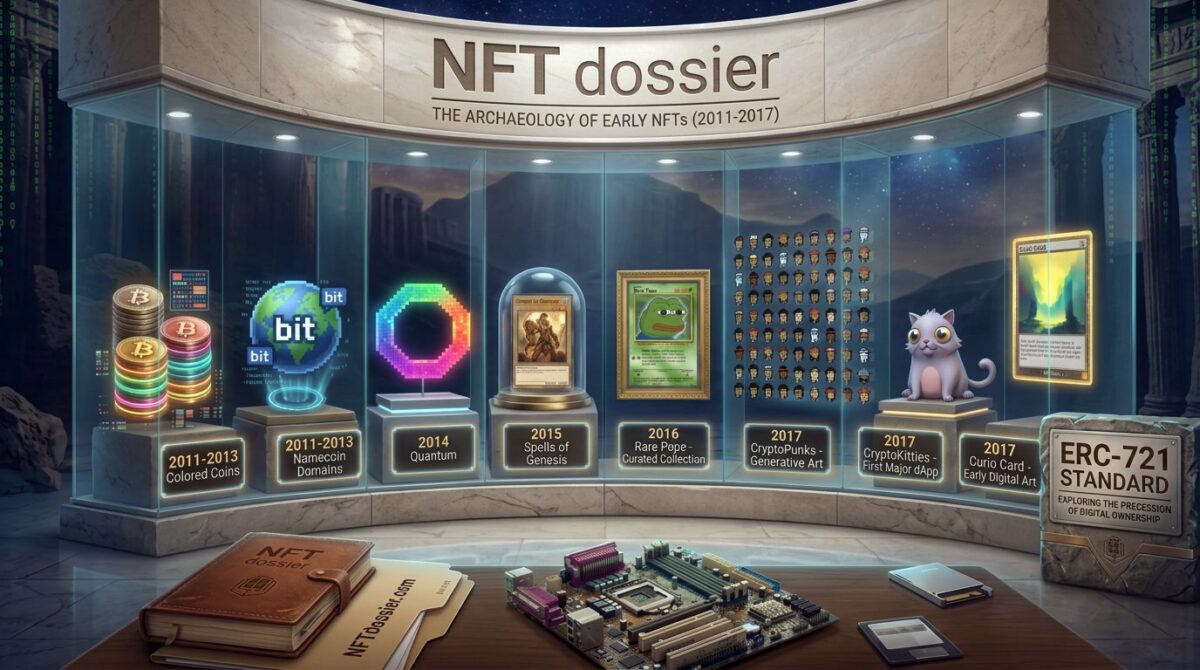
The story begins before the word NFT became commonplace, and before there was a standard way of creating one. Projects built on Namecoin, and later on Bitcoin through Counterparty, experimented with putting things other than ordinary currency onto a blockchain. Names could be registered. Tokens could represent artwork or trading cards. Some were issued in very limited quantities, sometimes just one. The blockchain did not make the picture itself impossible to copy. It couldn't.
What it could do was keep a public record of a particular token and who controlled it. The image might be copied a thousand times, but there could still be a recognised token associated with that particular piece. That distinction is easy to miss today. We are used to the idea of an NFT being a digital asset, but the people working on these early systems were still figuring out what that meant.
There were practical problems, too. How do you create a token that cannot simply be issued again? What happens when a name needs renewing? Where should the artwork be stored? How do you represent hundreds of different digital objects without creating hundreds of separate transactions? And what makes a digital collectible different from an ordinary token? There was no instruction manual. There were experiments.
From experiments to collectibles
As the technology developed, the objects became more recognisable. On Counterparty, people began creating tokens representing artwork and digital trading cards. Projects such as Spells of Genesis used blockchain tokens as part of a game and collectible system. Other experiments explored one-of-a-kind artworks, digital identities and virtual property.
The question underneath these projects was fairly simple: Can a blockchain provide a reliable history for something that only exists digitally? The people involved were not necessarily trying to build what we now call the NFT industry. There wasn't one yet. They were solving individual problems, experimenting with new possibilities and finding out what the technology would allow.
The early tokens can therefore look rather different from today's NFTs. Some are primitive by modern standards. Others can be difficult to understand without knowing the systems they were built on. That is part of what makes them worth looking at. They show the technology before anyone knew exactly where it was going.
Then came Ethereum
Ethereum changed the story by making tokens easier to program. Developers could create smart contracts, programs running on the Ethereum blockchain, that defined how their tokens behaved. They no longer had to build every new kind of digital object around a particular blockchain system. Early projects explored different approaches. Then came ERC-721, a standard for creating individually identifiable tokens.
The basic idea is easier to understand than the name suggests. Instead of having a collection of interchangeable tokens, each token could have its own identity. Token number 17 was not simply another copy of token number 18. That made it possible to build digital objects where each individual item could be distinguished from the others. Games could have individual items. Collectibles could have distinct identities. Artwork could be associated with specific tokens. Later, entire collections of thousands of individually identifiable digital objects would become possible.
By then, several pieces of the puzzle were starting to fit together.
Why the early history matters
Looking backwards from today's NFT world, it is easy to imagine that someone simply invented NFTs and the rest followed. The history is less tidy. There was no single moment when the modern NFT appeared. There were years of experiments, different blockchains, competing ideas and projects that eventually disappeared.
Some early tokens are difficult to classify using today's terminology. Calling every early blockchain token an “NFT” can make the history sound cleaner than it was. The language and standards came later. NFT Dossier follows that trail. Here you will find the early experiments, the people behind them, the unusual tokens and projects, and the problems they were trying to solve. Some became well known. Others are barely remembered.
Taken together, they tell the story of how something that could be copied perfectly came to have something else attached to it: a record of ownership.